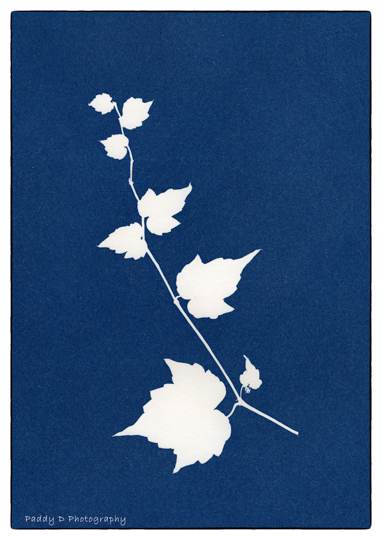
It's About Me Being Me:
Cyanotypes
A journey into alternative photography techniques, exploring the Victorian world of cyanotype prints.
Read more about the images in this gallery HERE …
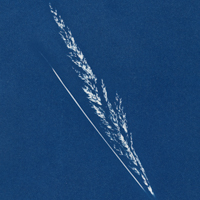
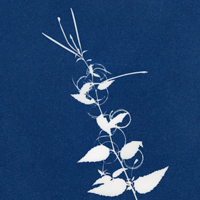
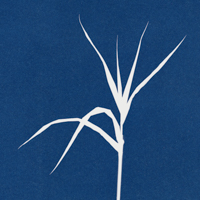
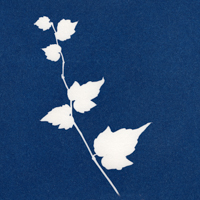
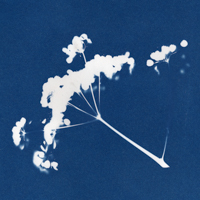
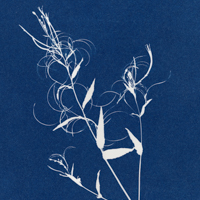
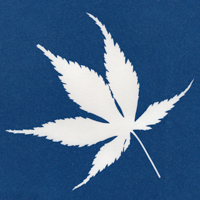
About This Gallery of Images
It’s about me being me: Cyanotypes
I’m sure you’ll find the phrase ‘me being me’ elsewhere on this website (and maybe ‘us being us’) because there are some things – some images or techniques – which resound with my identity and sense of self; and cyanotype printing is one of them.
Having said that, I guess that the whole website is about ‘me being me’ – after all, I wouldn’t want to share something which didn’t have my voice. So maybe it’s just about time and place, and need; and that cyanotypes are simply ringing the loudest bell just now.
In May 2022, when I wasn’t able to find the rhythm of wheelchair-photography, a timely remark by Rachel Wright led me into the world of cyanotype printing. I knew of it, though nothing more, but I was minded that Morag Patterson works with similar techniques (anthotypes and chromatograms). And so, inspired by them both, I crossed over to the dark side and into alternative photography techniques.
Cyanotype printing is an ideal medium for every facet of my character; my scientific persona revelled in learning the basics, doing test-prints, seeking consistency and repeatability, and recording the details of every print in a logbook (light source, paper type, exposure time etc); artist-me sought movement, fluidity, balance – and loved surprises! And the version of me with respect for people in the past, and a sense of history is engaged too; the part which wants to pay tribute to every woman scientist/engineer who preceded me – Rosalind Franklin, Lise Meitner, Dorothy Hodgkin, Caroline Herschel, Anna Atkins and more – all largely overlooked, oh, don’t let me get started!
I set myself the brief of working with the traditional, cyanotype process (as developed in the 19th century) using 220 gsm, pre-treated paper (i.e. fully coated with light-sensitive chemical solution from corner to corner by Renata Richards at the Cyanotype Co. in Cannock, UK) and a small UV lamp (the latter being my one nod to modernity); and most of my samples came from nature. I began with leaves – I reasoned that, being two dimensional, they’d deliver the best ‘footprint’ and be the most recognisable (oak leaves, Japanese maples, sycamores, ferns) – and flat-ish plants and grasses (herbs, crane’s-bill, carrot tops and willowherb) before venturing into the 3D world of seed-heads (common hogweed, smoke bush, sycamores). And with each step every part of my persona was enriched, absorbed, engaged, fulfilled – in a ‘state of flow’ as Mihaly Csikszentmihalyi defines it – and time simply disappeared! It’s a hands-on, tactile craft – an analogue skill that proceeds appropriately at a comfortable, analogue pace.
Cyanotype printing has another significant advantage – a physical one – that it’s a ‘now’ process, one which I've learnt since the fractures. So, unlike camera-photography, I've not had to modify or re-invent my pre‑fracture methodology (and deal with the way that feels emotionally). But, above all, the technique appeals to the child in me. She’s fascinated – bursting with curiosity – and learning a little more about the scientific process and the botany with every step.
Then what happened?
Initially I scanned every cyanotype for safekeeping – aware that each print is unique and lost forever if I drop it in the washing up! But, having digitised them, I stepped away from my authentic, 19th century brief and began to blend them with a selection of digital images from my back catalogue – feeling as I did it that the 19th and 21st centuries were in collaboration. And I soon discovered another rich avenue of experimentation – finding successful combinations of subject matter, colour, composition, texture and digital blending modes (and learning the hows and whys of the unsuccessful ones!)
Overall, I found myself leaning towards the soft, subdued colour palettes I could create if, firstly, I converted the digital image to monochrome and applied a selenium tone before blending in the cyanotype …
… or if I de-saturated the hues and then, digitally, made them chalky.
And now, where next?
Scientist-me created a diagram called ‘Making Sense of Alternative Photography’ – or maybe it should be ‘Trying to Make Sense of ’ – a diagram of options and possibilities. And just sampling it randomly I'll draw your attention to a few ideas on it – to hand-made paper; gold-leaf; free-hand calligraphy; anthotypes; digital negatives; wet-spray pre-treatment; moving subjects, double exposures. Again, there are so many avenues open to me I really am spoilt for choice!
Then and Now
In addition, I've still got a lot to learn about digital collaborations. But there’s one avenue in amongst the clamour that’s calling loudest and that’s hand colouring – the idea that I might be able to colour this cyanotype (the one above) to show the blush of red which tinged the leaves.
So, in keeping with my traditional brief, I’m starting to research the history of early, hand-coloured, Victorian photographs – the world of Felice Beato; the techniques he learnt from woodblock printing in Japan; ‘A Guide to Painting Photographic Portraits’ by A.N. Rintoul; the fundamentals of watercolour painting; and, in the longer term, pressing flowers to preserve them.
It's early days yet but I’m excited by the prospect – and that’s what matters. After all, it’s about ‘me being me.’
Stay safe
Paddy
Addendum – June 2023:
You can read a longer description of 'My Cyanotype Story' (written some months after I uploaded this gallery) together with a description of my printing process HERE …