
Learning from Trees and Woodlands
A Letter to Self
I'm finding it more difficult than I expected to get my ecclesiastical project started – I've taken several thousand photographs and edited several hundred; some fill me with pleasure but too many disappoint me. They're not making my heart sing!
But I've stood at these crossroads once before – in photographic terms, that is – stood on this exact spot, knowing that I'd taken a lot of photographs but wondering why they didn't feel 'right'. On the last occasion it was with my images of trees and woodlands – this time it's churches and cathedrals.
Am I just being impatient? After all, I spent three years learning about woodland photography and I had to build up my ideas and techniques from scratch – maybe that's what I need to do again.
So, what did I learn last time that will help me this time? Is there something I can transfer from trees to churches?
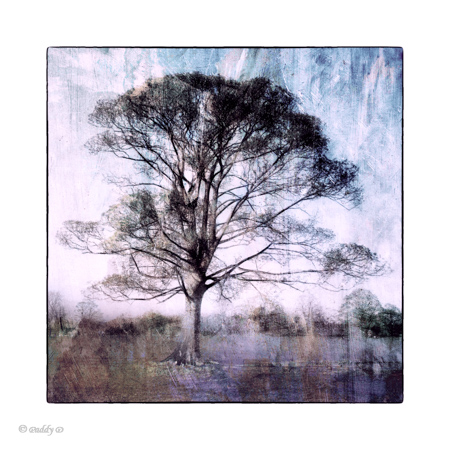
Roundhay Park, Leeds
I remember reading an article which asserted that woodlands are “difficult to photograph because they don’t follow the rules”. And whilst the former may be true (I did find them difficult at first) the latter isn’t. They do follow rules – but they follow the rules related to woodland photography, not the rules the author was obviously trying to impose on them (from landscape photography I’m guessing – presumably because both genre are outdoors and natural). So that’s my first piece of advice in my letter-to-self; take time to find out the new rules; don’t rush – enjoy the exploration; be imaginative, playful and childlike.
Another reminder – don’t expect a ‘one size fits all’ solution because my recent experience showed that photography of single trees differs from trees on the skyline, which differs from paths through woodlands, which in turn differs from the dense part of woods. And unexpectedly, they all have different persona – different rules and characteristics – in summer compared with winter, on a clear day or in fog.
Providing more detail, there’s an honesty about trees in the winter – you can see their form, their structure, their soul – but this is masked by the leaf canopy in summer, as if the trees are dressing up and hiding. So, when I engage with single trees in winter, I’m trying to make portraits which describe their character, whilst with trees on the skyline I’m playing with their silhouettes – sometimes imagining them poised on the hillside to attack, like a scene from the cowboy films of my childhood.
However single and skyline trees do have something in common – there's a physical distance between me and the trees; and that distance allows me to be an observer, to retain some objectivity and separation. In contrast (and the reason I distinguish ‘trees’ from ‘woodlands’) a woodland walk is a fully immersive experience (whether I’m walking along a path between the trees or looking into their depths alongside) and hence my reactions tend to be more subjective and more immediate.
So, the next point in my letter-to-self is to ask whether there are similar conditions in an ecclesiastical setting. Whether there are times when I’m an objective observer, and other times I’m an immersed participant? And immediately different experiences come to mind – that sense of distant, untouchable awe when standing at the west end of the nave in York Minster, or in Durham Cathedral, which is so very different from the enveloping intimacy of Harewood Church, where I’m watching Ian in ‘conversation’ with the effigy of Edward Redmayn (a very one-sided conversation you’ll understand!)
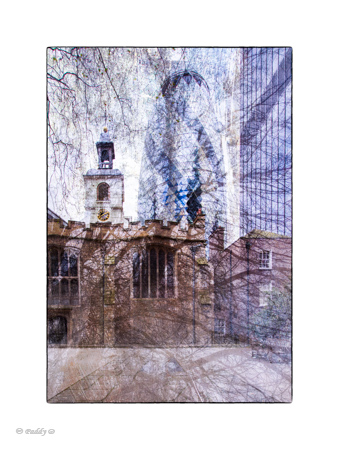
St. Helen's Church, Bishopgate
and a resilient, street-wise, city-savvy tree
Woodlands are the epitome of ‘every day a different experience’ – they’re constantly changing – there’s always growth and decay, movement by human and animal presence and by the wind. Different paths have different personalities. And my first thought is that churches are the polar opposite – they have a constancy, consistency, reliability. I can have the same experience at the early service at Lincoln tomorrow as someone did 500 years ago (or I imagine that I can). Moreover, they (mostly) have an east/west orientation, and so the sun travels around them in exactly the same way, illuminating the same parts of the aisle and the nave, at the same time of day; it’s so predictable I know what to expect, even before I step foot into the west end. How might I represent this phenomenon photographically?
But, on second thoughts, maybe there’s more similarity with woodlands than I first imagined.
Thinking about the different occasions we walk amid the trees – the different seasons, weather and times of day – the woodlands look different when it’s bright or dull, when the sun is high or low, behind us or ahead; the trees can feel alive, intriguing and alert, or pensive and waiting. And it’s the same in a church, whether it’s a bright day or a dull one; whether the sun’s high in the summer-sky or low in winter; whether it bursts through a stained-glass window, casting jewels of coloured light onto the stone-flagged floor; whether it’s a small, intimate church, barely lit by natural light through small windows or a massive cathedral with acres of glazed windows, artificial lighting and a massive electricity bill.
Similarly, the acoustic quality of woodlands can differ – some days you’re sure you could hear a pin drop, other days the sounds seem muffled, others are dominated by the sound of the wind. And churches are the same; whether we’re alone and it’s pin-drop quiet or there’s the insistent buzz of tourists, or the organ is playing, or there’s the background familiarity of a service in progress.
Then another thought; this time about the woodland scenes which continue to elude me photographically – the summer images which are drowned in impenetrable leaf canopy and verdant undergrowth. So, I’ll add a final warning to my letter-to-self; even though it’s church photography, don’t expect miracles every time!
It seems there’s plenty to help me here – ideas, skills and techniques – so the closing note in my letter-to-self, written in capital letters is …
DON’T BE IMPATIENT. DON'T RUSH
Enjoy it, savour it, relish every moment. It's not a race!!
Stay safe
Paddy xx