
Hearing the Music
(Part I)
I've had intermittent back trouble for over two years now, another arthritis flare-up, I was certain – most likely triggered by the stress and tension of the COVID pandemic, I assumed. But my condition deteriorated quickly in November 2021 and worsened further after Christmas and, cutting a long story short, I was diagnosed with severe osteoporosis at the end of January 2022 with the scans showing compression fractures in six vertebrae. They’re all healed now, but I’ve lost several inches in height and the shape of my spine has changed which remains a major problem (and probably a permanent one!) affecting everything I do – the way I stand, walk, sit, sleep and, surprisingly, take photographs!
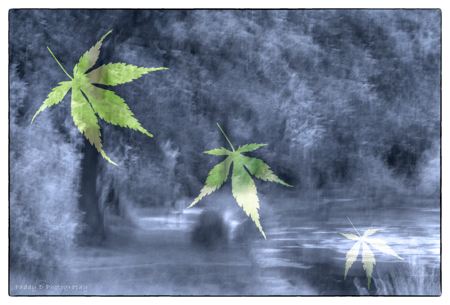
Then and Now
There are a lot of reasons for me to be optimistic – not least that osteoporosis isn’t life-threatening (thank the gods), though it’s certainly life-changing – for example, I was sure that photography and the camera(s) would be able to make a positive contribution to my ongoing mental reorientation and physical rehabilitation, just as it has done more generally in my life for several decades.
And there are also the life-affirming role models that I've encountered such as Emanuel Wallimann, writing on the internet:
“… as long as I can remember I’ve been in a wheelchair. In my life I’ve tried a lot of different hobbies, and almost every single time I felt compromised by my wheelchair… apart from taking photographs.”
At first this confidence in the camera was well founded. Maybe I looked like a little kid with a security blanket, but I believe there was more to it than that. I think it was about ‘me being me’, it’s what I do, it’s a statement about myself – I've photographs and photographic memories with film cameras which predate our Matthew, and digital images and memories spanning almost 20 years. The camera is a totem, reminding me and the wider world that I’m only in a wheelchair because I've got fractured vertebrae, NOT because I've undergone a total, irreversible change in my personality or intellectual capacity. But sadly, the photography itself wasn’t as satisfying as this ritual with carrying the camera.
In those early days, I subscribed to the theory that chair-photography is like ordinary photography, only shorter. But, after trial, error and a lot of frustration I realised that it’s not that simple, and that there’s no single, ‘one size fits all’ description of a wheelchair-photographer any more than there is a unique description of a wheelchair-user.
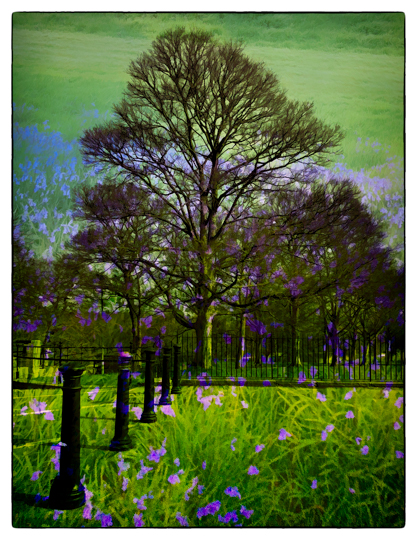
Trial and Error
Some images were more successful than others!
Now, as I write this next paragraph, I can hear our Matthew in my mind’s ear saying, “you were overthinking things again, Ma”, and I must admit he was right! My ‘other’ persona had come to the fore – she’s the scientific one – analysing the situation with all the engineering skills she’d honed over the decades, covering sheets of paper with hand-drawn diagrams and ideas, and compiling lists and tables of actions and alternatives.
Firstly, she-and-I concluded that I’m having to tackle the loss of many of my preferred ‘habitats’. We can’t take our favourite walks in the woods, for example, because the movement of the chair on the uneven, stony paths is like being in a cocktail shaker inside a tumble dryer. Secondly, there’s a change in process – a total loss of spontaneity – because I need to communicate precise instructions/directions to Ian, my gallant chair-pusher, whenever I see a scene which captures my photographic interest – a loss of independence and control. (I’m minded of our Matthew learning to drive some 20 years ago!!!) Then there’s the loss of precision, rhythm, exactitude and choice whenever I’m ready to take the photo. And on one occasion there was even an unpleasant, subliminal shift in the intended message of a photograph when an elegant, sweeping line of trees seemed to form a barrier. Were the trees telling me that I’m now to be excluded from the everyday world?
So yes, I understood the problem better – and I’d learnt that my initial, naive (and somewhat arrogant) assumption that my chair-photography would be just like all my earlier photography, only shorter was completely wrong! But no, it didn’t liberate my photography and make it fun again.
In truth, I’d have to say it made things worse.
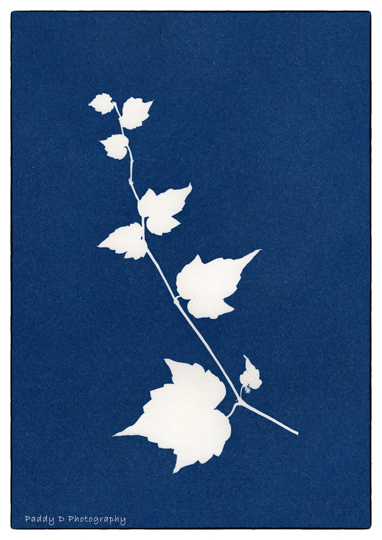
A Victorian-Style Cyanotype of Locally Foraged Ivy
Sometimes it feels like the 1950s and I've penfriends again, except that nowadays I’ve a dozen or more photography friends – like-minded souls around the globe – who I regularly meet online and who I feel very close to, even though I've never joined them ‘in the flesh’ (or IRL, to use modern parlance!) And it was a chance comment by one of them, by Rachel Wright, that started to relieve my mental and emotional dis-ease with photography.
Rachel mentioned ‘Alternative Photographic Techniques’ and my interest was piqued, flippantly at first, but then more seriously. I put down my digital cameras (temporarily, I hoped) and made a handbrake turn into the fascinating world of Victorian cyanotypes that she’d talked about, and into the illustrated books by Victorian botanist Anna Atkins. And soon I was looking into the traditions of hand-colouring Victorian photographs and Japanese woodblock prints, and exploring centuries of botanical illustration. Then I scanned and digitised the cyanotypes allowing me to create digital blends with my back-catalogue of landscapes and flower ‘portraits’; and then I …..
And I’m loving it.
I’m beginning to think I've been transformed from a 21st century pipeline engineer into a Victorian gentlewoman!!! So much so that, for my recent (big) birthday, I asked Ian to buy me watercolour paints and brushes, and a flower press kit.
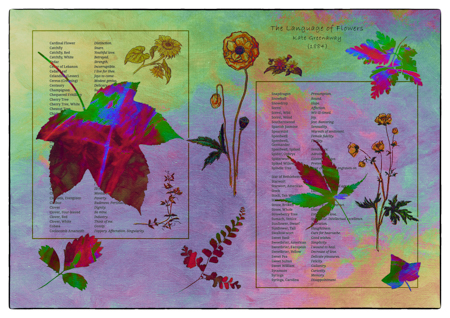
Being Transformed!
A digital collaboration between my cyanotypes and
‘The Language of Flowers’ by Kate Greenaway (1884)
But it was another chance comment at the end of an online meeting, this time by Noelle Bennett in New Zealand (she’s a classically trained musician and formerly an orchestra player) which proved seminal. She mentioned that she can't take photographs if she doesn’t have music in her head.
Music in her head – wow, it’s such an important statement, I almost feel the need to keep on, and on repeating it.
I inferred (correctly she later assured me) this to mean 'music in her mind' rather than just having headphones on, and it opened my mental ‘floodgates’, explaining why I've been finding camera-photography so unsatisfactory since the fractures. It’s not exactly the 'music in my head' but the 'noises in my head' – I've got too many noises in my head, and they’re forming some kind of barrier.
In turn, I was minded of an online book by John Suler called ‘Photographic Psychology’, and a chapter on ‘Mindfulness in Photography’ in which he says that:
“… internal [mental] chatter … acts like smoke that clouds our vision”.
And I knew then that Noelle had helped me find the key – that each of us must have the right 'music/ sound/ideas/stillness’ in our minds (delete as applicable) – and that, for my part, my head had been full of all the wrong stuff – full of distracting and disturbing 'chatter' which had been clouding out, maybe crowding out, my photography.
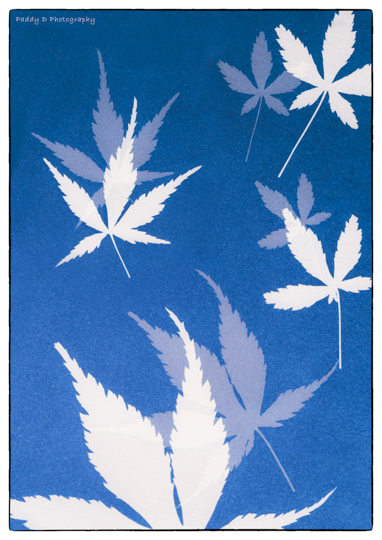
Another cyanotype, digitally transformed
Lastly, I was minded of the northern novelist, playwright and screenwriter Alan Plater, a favourite of Ian for both his writing and his love of jazz. There was a series of his on television in the 80s called ‘The Beiderbecke Trilogy’ which is oft quoted in this house (e.g. one of the characters, Trevor, loves jazz while the other, Jill, asks 'what time does the tune start?')
Specifically, ‘The Beiderbecke Connection’ concludes with this dialogue:
'Trouble is,' said Trevor, 'people don't hear the music. '
'Back to music?' said Jill.
'Certainly. What else is there?'
'Bix?'
'And Duke and Bird and Prez. '
'The Beiderbecke Connection. '
'That's the sanity clause. You only have to listen. '
'You know how to listen, don't you? You just put your ears together and …
'Hush,' said Trevor.
'Listen,' said First-Born.
They listened. They heard the music. Then, after they had eaten their sandwiches, they climbed into the little yellow van and drove into the sunset.
I feel quite excited, quite optimistic. Next time Ian, and me and the camera go out, I feel I can take inspiration from Noelle, and from Alan Plater, Jill and Trevor, and from John Suler too. And I'll be able to hear my music. I’ll be able to enjoy my photography.
Thank you.
Thank you all.