
Hearing the Music
(Part II)
I’ll say straight away that this isn’t the best piece of artwork I've ever produced – the cyanotypes are too distinctive in their natural form to play nicely with the central image (just like gangs of kids in the playground) – but, in terms of narrative, it tells the exact story I want to share with you. It’s the one that I flagged at the end of Part I, when I wrote that the “next time Ian, and me and the camera go out … I'll be able to hear my music. I’ll be able to enjoy my photography”.
And by ‘hearing the music’ I don’t mean that Rachmaninov’s Piano Concerto No. 2 was playing in my mind, or Shostakovich, or The Jackson Five!!! – but I’ll come back to that later.
So now my excuses are out of the way, I’d like to thank a handful of friends for helping me to ‘hear the music’ once again on a recent visit to St. Aidan’s Nature Reserve, and for enabling me to celebrate the experience. And this montage reflects the way they did it – how, in their different ways, they contributed to where I was, what I did while I was there, and what I did afterwards.
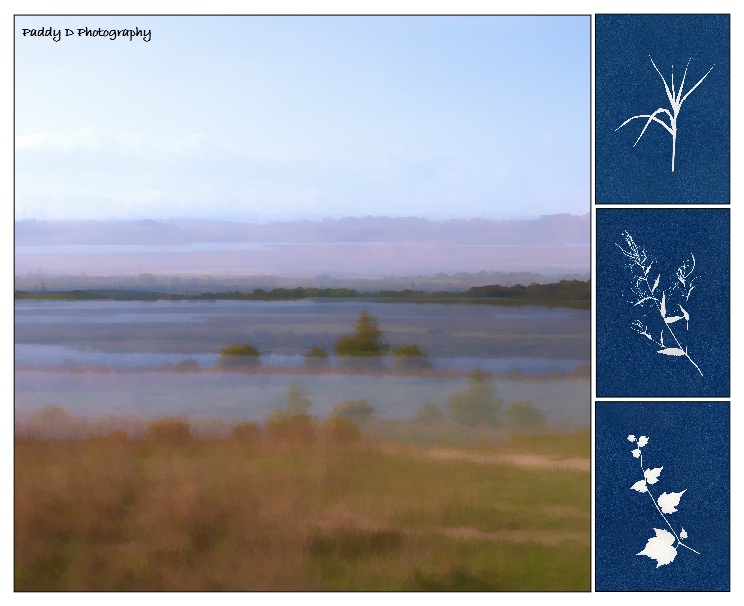
'Hearing the Music'
(with five friends)
So, starting with Morag Paterson …
I’d been listening to her talk at the Festival of Biodiversity held by the University of Stirling and Scotland’s International Environment Centre. And this prompted us, next day, to make the visit to St. Aidan’s Nature Reserve, southeast of Leeds and only a few miles from home. It’s a post-industrial site – formerly an open cast mine reclaimed by nature (and given a helping hand by Leeds City Council, the RSPB, staff and volunteers) – and now a “haven for wildlife … including bitterns, avocets, black terns, skylarks and meadow pipits”.
I’m not sure it’s an example of biodiversity but Morag did inspire the visit, and so this is where the story starts.
Next, I’ll introduce Ruth Davey and her online course which I took in the autumn of 2020, ‘Reframe Your Now: Mindfulness Photography for Mental Health and Resilience’.
One of the assignments encouraged me to take ‘curiosity walks’ (as I later named them) – walks in which childlike curiosity, focus and observation replace the tendency to get on, rushing from pillar to post – and subsequently I wrote:
Too often in the past, I’ve taken these same walks around our neighbourhood, but done so on autopilot while my mind continues to struggle with the anxieties and concerns of the moment. The problems which had overwhelmed my mind indoors remained the problems which overwhelmed my mind outdoors. And I suspect, my body continued to be tense and anxious, my breathing shallow. But, when I’m on a Ruth-inspired-walk, my mind is fully engaged with the world around me; instead of anxiety and distress it’s busy being amazed, intrigued, fascinated – it’s a time of mental respite. I return home soothed and calm, more positive, less distressed, less self-critical.
Intermittently, over the years, I’d tried meditation, but my empty mind always opened an invitation for anxiety to flood in. Whilst, in contrast, Ruth’s ideas and techniques were different – maybe providing the childlike distraction my mind needs when it’s anxious! Her techniques had proven to be a vital stepping stone from dis-ease to a more mindful state – the first, the only way I’d been able to achieve it. Subsequently, I discovered that I could be “curious and observant without a photographic-prompt and it’s just as beneficial to my wellbeing”. But, thus far, I’d not been able to replicate it from the wheelchair, with or without the camera – not until St. Aidan’s, that is.
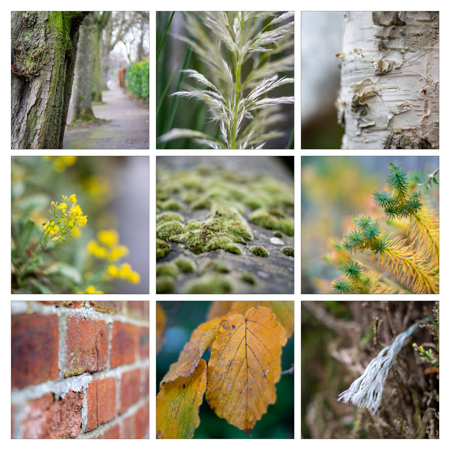
Beauty on My Doorstep
(taken on a curiosity walk in 2021)
Now it’s time to bring Noelle back into the limelight (I introduced her in Part I) and talk about ‘hearing the music’ – a shorthand for her self-understanding that she can't take photographs if she doesn’t have music in her head.
The significance of that comment is that, as I wrote earlier, it enabled me to start making connections (in that random way one’s mind can work) between Noelle ‘hearing the music’ and John’s Suler’s assertion that “… internal [mental] chatter … acts like smoke that clouds our vision”. And now, as a goal, I could add the way I felt when I was on a curiosity walk.
I knew that Noelle had helped me find the key – the explicit awareness that I’d been trying to take photographs while my mind was hearing the wrong music. Worse, that my analysis and over-thinking had simply added more distractions and disturbance, made my (mental) vision cloudier, and made a favourable outcome less and less likely.
Moreover, when making that assessment I’d missed one vital component – an appreciation of the role the camera had played on my curiosity walks. If asked, I’d have told you that it added a sense of purpose and validation to the walk, helped me engage with the minutiae of my surroundings and ensured that I disengaged from the ‘internal chatter’ in my head. (It’s also the perfect explanation for any baffled passer-by who sees me being curious – i.e. it’s not as weird as it looks, I’m doing a photography assignment!)
But I’d underestimated (been oblivious, in truth) to the fact that, in recent years, it was both the camera and the physical act of taking photographs – the soothing familiarity of the entire process – which sparked, and then aided my mental journey from anxiety to mindfulness. But now, on its own, my confidence with the camera can’t compensate for the awkwardness and dis-ease of working with it from the wheelchair. The camera was no longer part of the solution, it was part of the problem – another distracting, discordant noise – that stopped me hearing the right ‘music’ in my mind’s ear.
And then a breakthrough – my ‘road to Damascus’ moment – I realised that, for me, it’s not about hearing the music (not like Noelle, and Trevor in the Beiderbecke Trilogy).
It’s not what I hear, it’s what I don’t hear.
It's about not hearing the relentless bombardment of internal chatter, the beehive-buzz of anxiety and over-thinking. It’s about quietude and mindfulness – being at ease with myself and my immediate surroundings. Then, and only then, would I be able to pick up the camera and enjoy taking photographs again.
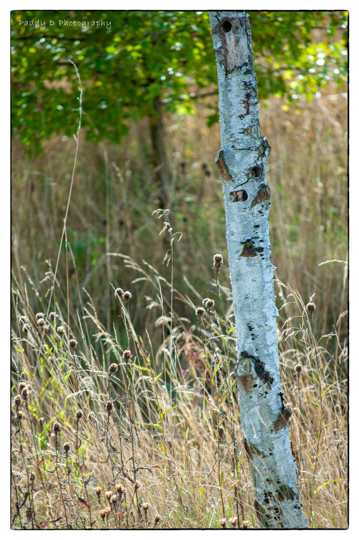
“At ease with myself and my immediate surroundings”
Somehow, all this came together when we were sitting outside the café at St. Aidan’s, and I engaged with the locality in the manner that I’d oft done in the past when taking long exposure photographs. Emulating W.H. Davies (the Welsh poet), I took time to “stand and stare” or, in this case, sit and stare.
I can’t tell you why it happened, how it happened, or what was different on that specific day, at that specific time. And I can hear our Matthew again, warning “you’re over-thinking, Ma” so I’d better not try (and instead I’ll accept it as a gift from the gods).
Somehow, somewhy, I didn’t need to embark on a curiosity walk, I ‘just’ relaxed; I heard the birdsong, the distant hum of traffic; listened to the rustling grasses; watched the faraway passage of birds overhead; noticed braver individuals foraging nearby. For the first time in over two months I asked Ian to get my camera from the car. And “at ease with myself and my immediate surroundings”, I started taking photographs again – nothing earth-shattering, nothing exhibition-worthy – just simple, relaxed, fresh observations, ‘snapped’ whilst I was feeling calm and almost playful.
What a moment.
What a moment!!
A moment to savour.
In the next half hour, I took 39 photos in all (quite a modest harvest for me) but they were 39 more than I’d taken, and certainly 39 more than I enjoyed taking, for months. I started by looking out towards the horizon – the images show the expanse of the wetlands and a ‘big’ sky (like the central one in the montage) – but then my focus shifted closer to home (well, closer to the place where we were sitting) and I added plants and grasses, a tree-stump and a magpie (then, oops, the tree-stump but no magpie).
Yes, certainly a time to savour.
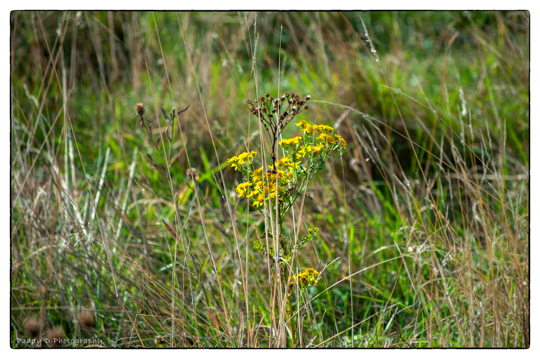
Looking closer to home!
I didn’t imagine that the day could get any better but, as we left the café, I was minded (another random connection!) of an arts and nature community project inspired by Helen Thomas called ‘Dandelions and Double Yellows’ in which she “encouraged people to notice, and share responses to, spontaneous flora in our neighbourhoods … to reconsider the often overlooked, unplanned plants in our everyday surroundings.” And so, instead of going straight to the car, we walked round the carpark looking for the ‘overlooked’.
I can’t name many of the plants we found (I should have paid more attention to those nature walks at school when I was a kid). But, giving you some ideas, a member of the Wakefield Naturalists’ Society wrote a few years ago that “… looking around the edge of the car park area we saw bristly ox-tongue, cut leaved cranesbill, spotted medick, water figwort, wood forget-me-not and, in the fenced area, clumps of weld and celery leaved buttercup.”
However, the lack of nomenclature didn’t deter us, and like a pair of furtive shoplifters, we collected several specimens when (and only when) the plant was in abundance.
And now (last in sequence only) comes Rachel Wright, whose contemporary, experimental, alternative photography inspired me to embark on making cyanotypes. So, when we got back home, I pressed my gatherings (like the quintessential Victorian gentlewoman I’m becoming) and then, a few days later, created cyanotype prints of them, including the ones you see here.
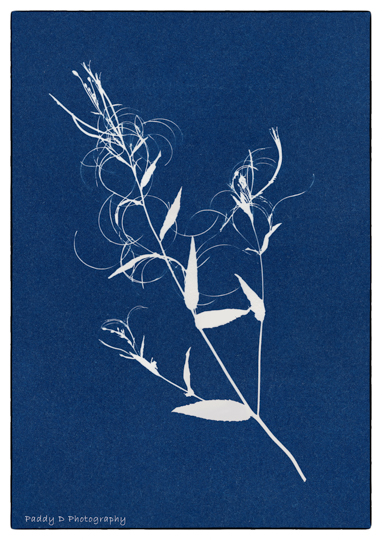
Willowherb.
Possibly!
Botanical nomenclature uncertain, but there really
was a lot of it growing round the car park
Looking back, I knew this was a momentous occasion which should not, must not, pass unnoticed. And that’s why I’ve tried, in creating the montage at the top of this page, to record and celebrate that day at St. Aidan’s. Afterall only three of us actually went to St. Aidan’s – Ian, me and the camera – but it felt more like a group outing with a handful of friends, all of whom left their very positive marks on both the visit and on me, and have changed the way I feel now (and look to the future) for the better.
My thanks to all of them.
Stay safe.
Paddy xxxx
(And now Ian's asking, when are we going out again – us three – him, me and the camera!)
Afterword (aka 'Related Items')
I've written more about the magical land of St. Aidan’s twice, firstly HERE …
and secondly in relation to the course I took run by Rachel Wright HERE …
And Ruth Davey’s course HERE …
And about long exposure photography and W.H. Davies HERE …
And there's a gallery of my cyanotypes HERE …
You can also see more about the work of:
Morag Paterson at www.leemingpaterson.com
Helen Thomas at www.toastedorange.co.uk
And Rachel Wright at www.rachelwrightphotography.com