
About Creativity
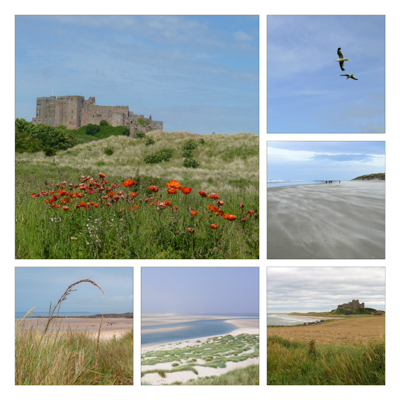
'Memories of Bamburgh'
I was re-reading John Berger a few months ago and I came across this quotation:
“In a painting all its elements are there to be seen simultaneously. The spectator may need time to examine each element of the painting but whenever he reaches a conclusion, the simultaneity of the whole painting is there to reverse or qualify his conclusion.”
John Berger, ‘Ways of Seeing’, 1972
And this time it was the words ‘elements’ and ‘simultaneously’ that jumped off the page – leading me to make the connection between a story-image and a painting. Until then I’d likened the process of ‘building’ a story-image to curating an exhibition, or composing a photobook but this highlighted a significant difference – that the viewer sees a story-image as a single entity, without the peripheral distractions of other people in a gallery or the physicality of turning the pages of a book. It helped me understand that a story behaves like a single image (albeit a fractured one) and therefore follows the same 'rules' as the single image but with the individual elements taken collectively.
Thus the layout of multiple images in a story equates to the composition of a single image; the key image in a story – the one which first focusses the viewer’s eye – equates to the subject; and I select the key position for it, just as I would when composing a photograph in camera. And then continuing the ‘single image’ analogy, there are a myriad of issues to consider as I create the story – proportion and scale, balance, rhythm, movement, line, pattern, white space, corners and edges etc. The ‘rule for horizons’, for example, is also the same as any conventional landscape; they need to match up across the layout or be wildly different – otherwise they distract the viewer’s eye from the intended message.
So that’s a description of the basic technique and concept – both are simple enough. But that simplicity undersells what follows – a fascinating, absorbing iterative process whereby I flip to-and-fro between image-selection, editing, and re-positioning – picking different image-options, adjusting tones and colour balance, changing the layout to increase the energy and rhythm, re-cropping to maintain the ‘rule of horizons’, etc. And this continues until I feel ‘at ease’ with the montage – comfortable that it’s visually harmonious and balanced, and that it tells the story I want to share with you.
It bears repeating that this, I think, is one of the pleasures of storytelling – this absorbing, creative, fascinating phase with its challenge of juggling and combining all the disparate elements. It ensures I stay in close contact with the entire body of images and their spirit; and this, in turn, creates a ‘sense of wholeness’ – a sensibility that runs throughout the entire process.