
Landscape
The Images
For my first home-play, I created a series of three images about St. Aidan's Nature Reserve, an RSPB nature park only ten miles away from us in Leeds.
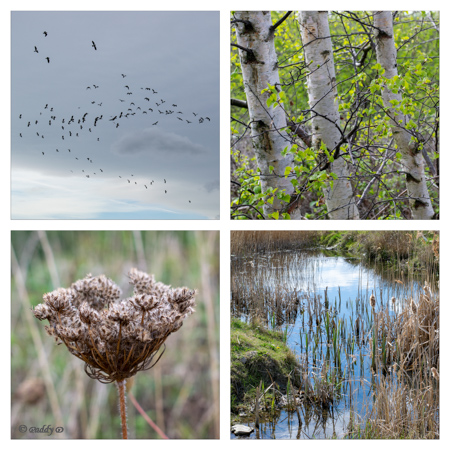
Nature at its Very Best
The Story
St Aidan’s is a place of delight and wonder – nature and green therapy at its best – with reed beds, trees, birds aplenty, and a very, very big sky. It’s a wash-land which helps with the management and control of flood water on the River Aire which runs alongside, and it also helps protect the breeding-habitat of rare birds like bitterns, marsh harriers and bearded tits.
But it’s actually a post-industrial site – an old open-cast mine which produced coal until 2002 – and you can’t get away from this industrial past. A massive dragline excavator, curiously named Oddball, sits up on the hillside and is visible across the entire site.
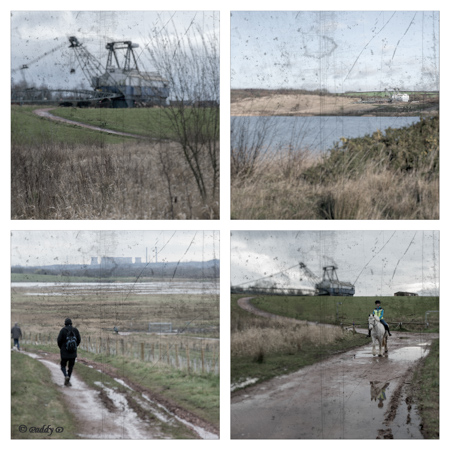
With Oddball up on the Hillside
Mostly I admire the way that the site has been regenerated – given such a positive, ecological and beneficial role. But here’s the paradox – a small part of me fears that it contributes to a culture which sanitises and gentrifies our heavy industries. When I look up at Oddball – an immense behemoth – I'm minded that, years ago now, I was involved in a pipeline project at a steelworks. And, despite the passage of time, I can still recall the noise, the heat, the vibration – and my almost paralysing terror! And I’m certain that the physical reality of a working open-cast mine, with thundering-Oddball at its centre, is strikingly different from the impression that retired-Oddball creates as it sits benignly on the hill, overlooking the nature reserve in an almost protective manner.
And there’s a second issue – did Oddball terrorise the land, tearing it apart in pursuit of coal? Was the land as terrified as I was?
I wonder whether it’s still crying out beneath us.
If I listen closely, would I hear it screaming?
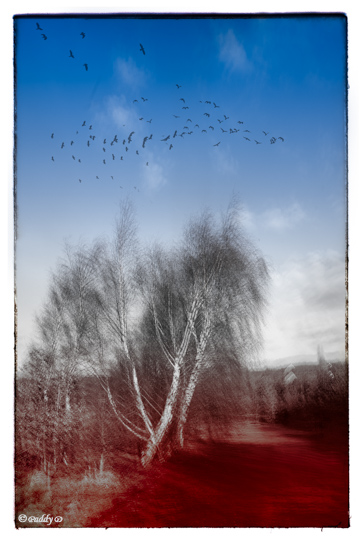
Can I hear the land screaming?
In Retrospect
I'd always imagined that 'proper' landscape photography is about distant, exotic lands, and involves physical hardship (and possibly danger) for the photographer. And when Rachel opened the session with the work of Ansel Adams, Galen Rowell and Edward Burtynsky I thought that my worst fears – this deep-seated prejudice – would be reinforced. But then she introduced Rob Hudson (whose work I already admired and who "immerses himself in his local surroundings") followed by one of her own images with a local setting. My eyes (and my ideas) began to widen – I relaxed and felt excited.
She talked about the 'intimate landscape' and, when I Googled the phrase later, I encountered an exhibition of the same name, with Eliot Porter's photographs. It included woodlands, tree trunks, a river bank – the antithesis of my definition of a 'proper' landscape. Slowly, my own local landscapes felt less trivial, less parochial and they started to rise in my estimation.
With Rachel’s help I can now see that landscape photography is not measured by the physical scale of the area it covers, or on the physical demands it places on the photographer, or by the photographic style or technique which is adopted. Simply it’s the landscape which the photographer engages with – large or small, near or far. It means the environment they're passionate about, that they want to explore and to create their personal interpretation. And, in these terms, St Aidan's is a very 'proper' landscape – it's my landscape!
Looking back on the series I created, the final image of the land screaming is also significant because it shows that I can be inspired by 'proper' photographers – Galen Rowell, Ansel Adams, Rob Hudson Edward Burtynsky – the type of photographer who had intimidated me before Rachel's intervention! Even though the subject of their individual images doesn’t always resonate with me, their ideas and feelings do. And this inspired me to embed their different styles in my image. Moreover, they’ve helped me represent a long-standing idea about the paradoxical nature of St. Aidan's which, hitherto, I hadn't been able to express.
Now, looking at the series of images, I’m experiencing a strange set of emotions. The first is increased compassion towards the land – maybe this is the first-hand, personal prompt I needed towards greater ecological and environmental awareness and activity. Next is relief that I've found my ‘voice’ at St Aidan’s – that I’m able to express this specific feeling, this specific notion, after the years of being frustrated by it. But overpowering everything is a wider appreciation of the creative expression which this series represents – creativity being something I struggle with consistently in my journey from engineer to artist – and my excitement, my exhilaration that I've experienced it, that I understand where ‘within me’ it came from and that I was able to weave it throughout the work.
Maybe, if I've achieved this here, I can do it again!
And writing this I’m smiling because that was just the first week of Rachel’s course, and I know just how many more treasures there were to come.