
Being Skippy
Originally Posted: August 2013
Yesterday I talked about Lady Eastlake and the essay she wrote in 1857 which includes the brilliant comment ‘Photography, thy name is disappointment!” [ HERE … ]. And so I tried to leave her disappointment behind her for this piece.
I tried to find a photograph showing her sunny side – showing her radiance and happiness, showing her skipping through the bluebells. But maybe she wasn’t a skippy sort of person. Or maybe the photographers (David Octavius Hill and Robert Adamson – who photographed her more than 20 times in the 1840s) weren’t the sort to crack the jokes and have her rolling in the aisles. This photograph (from the National Galleries of Scotland Collection) is the closest I can get to Lady E being skippy!
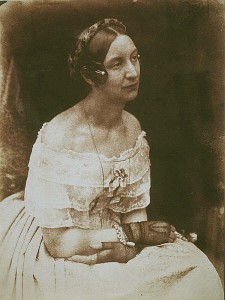
by David Octavius Hill, and Robert Adamson
But returning to her essay, another of her comments that caught my eye is:
“ … short of the coveted attainment of colour, no great improvement can be further expected [in photography].”
And my first reaction was amusement at her lack of prescience. She was certainly wrong about the development of cameras.
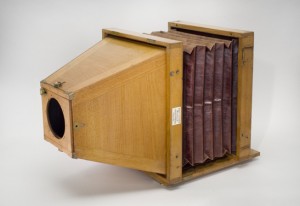 The one alongside was first manufactured by Ottewill & Co in 1857 (i.e in the same year that the essay was published) and was advertised as “the most portable as well as the lightest camera in use”. And, “when collapsed and folded flat, the camera measured only 13 by 10 ½ by 3 ½ inches.” (according to the website for the National Media Museum).
Only 13 by 10 by 3 inches?
That's only 33cm x 27cm x 8cm?
Only?
But that’s huge – even when folded flat. That’s almost the size of two volumes of the Encyclopaedia Britannica stacked together. I’d hate to have used their less-portable ones! Today we expect a light and portable camera to be about the size of a credit card! So I’m really glad that Lady E was wrong and that there have been great improvements in camera design.
My second reaction was that I’d never read anything like that in an essay today – not nowadays, when that the extent of change and the rate of change in technology, medicine and science are so amazing, totally inconceivable even 30 years ago (when our Matt was born). The old comment about ‘yesterday’s news, tomorrow’s fish and chip wrapper’ can be applied to more than just current affairs. We assume things will change, expect it – even though we can’t visualise it, imagine it – what or how.
And with all those considerable benefits of hindsight I’m far too aware of what hadn’t happened by 1857. The research for Pasteur’s Germ Theory occurred in the 1860s; ‘On The Origin of Species’ was published in 1859; the SS Great Britain was launched in 1858; the Nursing School at St Thomas’ was opened in 1860.
And Marks and Spencer, that essence of civilisation, only began in 1884!
But then, prompted by Ian (or should I say ‘prodded’ by Ian?) I realised that hindsight is, at best, unfair – at worst, patronising. Those Victorians had seen Britain transformed by the Industrial Revolution; seen the massive expansion of Liverpool, Leeds and Manchester; built the railways, the Mechanics’ Institutes; were about to start improving public health.
And in photography itself, Lady E noted huge advancements.
The first examples she saw had consisted of a “few heads of elderly gentlemen … little more than patches of broad light and shade” whereas “portraits of the most elaborate detail, and of every size not excepting that of life itself” could now be achieved
… “blurred and uncertain” landscapes had been “superseded by large pictures with minute foregrounds”
… “small attempts at architecture have swelled into monumental representations of a magnitude, truth and beauty which no art can surpass”
… and “last, and finest, and most interesting of all, the sky with its shifting clouds, and the sea with its heaving waves”
No wonder she thought that photography had (almost) reached its pinnacle!
Take care
Paddy xx