
Still Life
The Image
My still life was inspired by a painting from the 19th century by the Impressionist artist Berthe Morisot – ‘Still Life with a Cut Apple and a Pitcher’ (1876).
I aimed to juxtapose our lives by replacing her setting, of a chopping board, with the two volumes of my university thesis in my still life ‘Opportunities’.
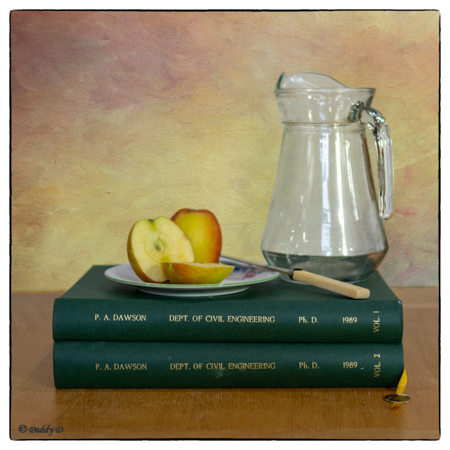
Opportunities
The Story
I’m constantly aware that my life is markedly different from those of my female forebears, in terms of my educational and career opportunities, in what I’m legally entitled to do and in what society permits me to do (or at least grudgingly accepts me doing!) And I tried to represent a fraction of this in ‘Opportunities’.
I didn’t have to leave school at 14, like many of the generations before me. I wasn’t directed towards teacher training college, secretarial college or into domestic sciences. I wasn’t educated in the ‘gentle arts’ and prepared for a ‘suitable marriage’ as was the fate of many women in the 18th and 19th centuries. It wasn’t assumed that my education would be a waste. Instead, I went to the University of Leeds and read Civil Engineering.
I can go out in public without a male escort; vote in elections; drive a car; have a bank account; gay marriage is now legal. I continued working after I got married, and returned to work after Matthew was born. I held the senior position of Principal Engineer in two engineering companies, supervising male juniors; published papers in my own name; have two degrees. I am chartered with the Chartered Institution of Water and Environmental Management and have professional recognition (and letters after my name) from a handful of others; I used to have European accreditation!!!
Female contraception has been available – and my choice – for my entire adult life; similarly, HRT; abortion is legal; child and maternal mortality rates continue falling; I’m unlikely to die from smallpox, cholera, TB, diphtheria, polio or smog, nor made deaf or partially sighted after contracting measles.
In contrast, Berthe Morisot experienced all the difficulties, health threats, social restrictions, misogyny and contradictions of 19th century life. Although she’s been described as one of ‘les trois grandes dames’ of Impressionism, she was lost into the ‘dustbin of women’s history’ (as named by Jackie Fleming) and is now called one of the ‘forgotten’ Impressionists. And whilst admirers of that modernist genre lauded her male contemporaries for painting real life – in the cafes and bars, dance halls and railway stations – women were precluded from these ‘racy’ settings, still expected to observe polite social convention. In consequence, they were criticised for the subject matter of their paintings being too domestic – the patronising, double-edged compliment being that their work was full of “feminine charm”.
And as for contemporary support and encouragement – Berthe’s brother-in-law Edouard Manet said about her and her sister Edma:
“What a shame they aren't men; nonetheless they might, as women, serve the cause of painting by each marrying an academician”
Families, eh!!
In Retrospect
Thinking back to the session, Rachel quickly dispelled the outdated and downbeat ideas I had about the genre of still life!!
At best I had imagined engaging with the exquisite botanical images of Ron van Dongen or the quiet, intimate world of Josef Sudek, thinking they might both revive my interest in flower photography. But mostly I’d expected photographs imitating drear paintings from earlier centuries, laden with dead birds and fish, and every possible representation of memento mori. My gran used to have a large reproduction of a particularly depressing Victorian painting of Hound Gelert hanging on her wall when I was a kid. And, for some reason, that always comes to mind when I’m looking at old still life paintings.
How could I be so wrong? What an exciting genre! What potential!
I was surprised to realise that the genre gives the artist the opportunity to construct a visual document of their idea – a tableau with the power to tell a story, make a political comment, an observation about society, a portrait of a life. Looking back over my notes, ‘Opportunities’ was only 1 of 12 different ideas I had for my home-play – ranging from the inclusion, opportunities and representation of women and girls in sport (now and in the past), to the story of my Mum, told through the objects we kept after she died.
Importantly, I came away from the session buzzing like a 5-year-old on a sugar rush, bursting with excitement. This opened possibilities I never knew existed. And is, I know, a genre which will encourage me to challenge myself.
And that was only Week Two!