
It all begins with Cyanotype Printing and then …
As I've mentioned before, Susan Sontag wrote that:
“The inventory [of images] started in 1839 and since then just about everything has been photographed … “
From ‘On Photography’ – a collection of essays (1977)
And I believe that one could say something similar about cyanotype printing:
The inventory started in 1842 and since then just about every botanical specimen has been printed in the manner of Anna Atkins …
Everyone who writes or talks about cyanotype printing cites the work of Anna in the 1840s. They tell you about her 3-volume book; that she created at least 17 copies of it, some volumes running to over 400 plates; that it’s a companion to the ‘Manual of British Algae’, an unillustrated publication by William Harvey; and (most significantly, in this context) that it’s entirely produced by the cyanotype process – every botanical illustration, every plate name for every specimen (in Latin), together with all her hand‑written text!!
No one surpasses Anna Atkins in her creativity and artistry, and certainly not her dedication and diligence. (I also talk about her, HERE … )
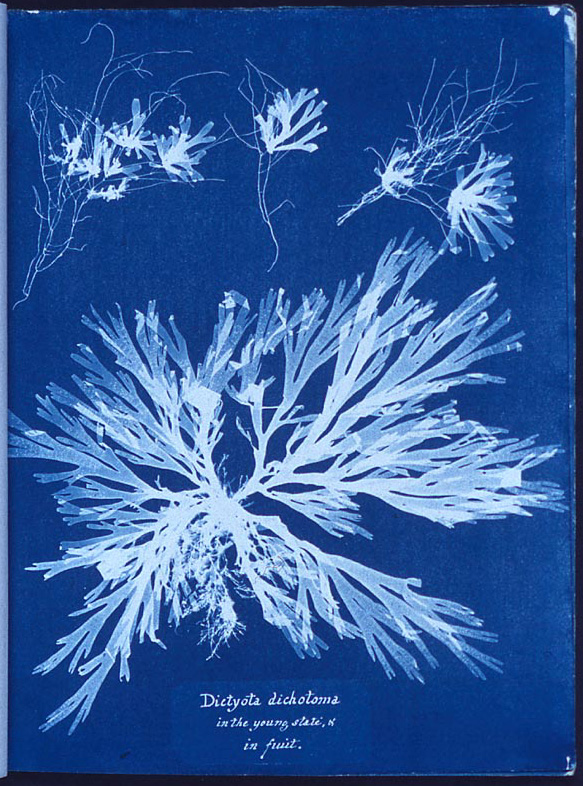
An algae:
A cyanotype print by Anna Atkins
But, in part, her rigour was well rewarded because the one key characteristic of the ‘basic’ cyanotype print – the type that she was making 175 years ago – is that it’s quite easy to do. It’s easy to produce a pleasing print – easy to demonstrate one’s competence. One can attain the ‘gold-standard’ that she set because, in practice, there is only one standard. It’s a science, not an art – if you do it ‘correctly’, you get the ‘correct’ outcome. Yes, a few of my initial attempts at the process should be labelled ‘oops, that didn’t work’, but soon my prints became predictable, repeatable, consistent. They’re beautiful; exquisitely delicate; richly blue (see my gallery of prints HERE …) But, in truth, the basic cyanotype process is so well ‘behaved’ that its predictability becomes, dare I say it, a bit boring.
So, at this point, like every other cyanotypist (is that a word?) I've started to think of ways to make my prints more …
More what?
Well, more surprising, I think – I don’t mean shocking – I just mean unpredictable. More interesting, unique, unexpected. More fun, more playful, childlike. I want to find ways of starting the process with the idea, ‘I wonder what will happen if I try …’ – and be truly uncertain, full of wonder, imagining the outcome. I want to allow myself to fail – not hide within the safe security of the basic process.
So the scientist in me drew up a list of the different stages/components of the printing process; the light source; the light-sensitive solution; the substrate and its preparation; pre-treatment; post-processing. (Not to mention the subject itself, and whether it’s stationary or moving). And then the different possibilities and variations within each category – a seemingly endless list including cyanotypes or anthotypes; chemical composition and balance; applying the solutions myself (rather than buying pre-treated paper); using special, hand-made paper; wet printing; bleaching and tinting; hand-colouring; multi-media collages; adding gold-leaf; and more. I could ‘collaborate’ with water, in the style of Marianthi Lainas; or (attempt to) imitate the work of visual artist Rachel Wright; or maybe I could …
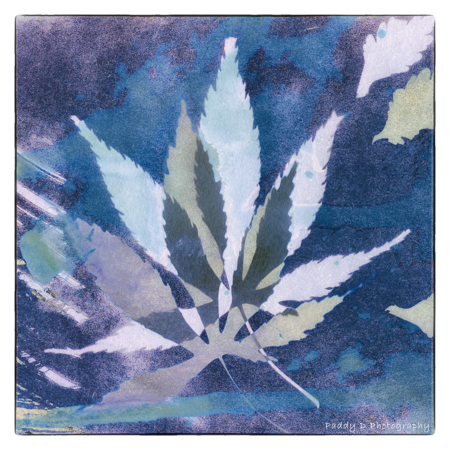
I’m sure I’ll take the time to explore some of these ideas in the coming months – I've already started ‘dabbling’ with hand-colouring the prints, using watercolours (after the manner of early hand-tinted photographs) – but, for now, I’m most drawn (the pun may be intended) to digitising the cyanotypes and blending them with a selection of digital images from my back catalogue (a technique I’ve discussed previously HERE … and shown in my image above).
But how might I proceed?
Thus far, my blending has tended towards serendipity – I've randomly selected a cyanotype print, randomly selected a digital image and, you’ve guessed it, blended them randomly! But now I want to develop a well-planned, fully integrated project. I want to create bespoke cyanotype prints and select specific digital images with a particular endpoint in mind – something which has a theme and a narrative which reflect the way I’m feeling now.
And then …
Watching ‘Sky Arts Landscape Artist of the Year’ last night, I heard an artwork described as being:
“… created while the artist was living in Taiwan, and represents the connection between her and her brother while they were living on different continents. It was inspired by … “
And suddenly an idea that’s been floating round my mind (unformed and out of reach) for some weeks now comes into focus and I can ‘hear’ the opening lines of my artist’s statement:
‘This project, ‘New Normal – Living with Severe Osteoporosis’, was created after I experienced multiple compression fractures in my spine. I wanted to represent the connection – strictly, the disconnection – between my life before the experience and my life since then; and to explore whether a project could deliver therapeutic benefits which would help me make a better transition to my new, semi-able life. It was inspired by a series of images created by the artist-filmmaker, Jean Hogg …’
Wow!
In truth, this feels a massive challenge. I don’t know if I’m being hard on myself, but I’m suddenly aware that hitherto I've only ever ‘stumbled’ into my projects – they’ve evolved naturally from the work I've been doing rather than being a planned form of communication. They’ve started with me being playful and/or experimental and, from that unformed beginning, a theme has developed organically. Moreover, this new approach is also encouraging me to ask, ‘what’s my art about?’ because I’m not sure I've ever seen my images as being little more than ‘pleasing on the eye’ – typically, I create something that ‘works’ and formulate a rationale, post hoc!!
Now I understand there’s a duality – there are different ways of starting a project. I’m sure I’m not alone with the ‘stumbling’ approach. I’m sure that many artists have started a project that way (but, with greater confidence than me, they tell us it was inspired by x or y!) But there’s also a pre-planned, pre-defined, pre-imagined alternative.
But can I do it? Can I ‘write’ a visual essay? Choose what I want to say to you, share with you – and then do it as an artwork (rather than verbally, in my stronger medium)? Can I plan it and execute it (instead of working it out as I go along and then telling you about it, afterwards)?
I've no idea. But I’d like to try.
Stay safe xxxx